

Haskell-KU Student Research Symposium Set for Friday
Twenty-nine undergraduate and postbaccalaureate scholars supported by research training programs at Haskell Indian Nations University (HINU) and the University of Kansas (KU) will present posters of their research at the 26th annual Haskell-KU Student Research Symposium, organized by KU’s Office for Advancing Success in Science (OASiS). The symposium will take place from 4 to 5:30 p.m. on Friday, April 17 in the Stidham Union at Haskell Indian Nations University.
Supported by grants from the National Institutes of Health, the National Science Foundation and the U.S. Department of Agriculture focused on training and workforce development in the biological sciences, the programs include:
- Bridges to Baccalaureate Research Training Program at KU/Haskell Indian Nations University | Principal Investigators: Josephine Chandler, KU; Nana Allison-Brewer, HINU; and Melissa Holder, HINU.
- HINU USDA-NIFA Equity | Principal Investigator: Nana Allison-Brewer, HINU; Program & Land Steward Manager: Courtney King, HINU.
- Kansas IDeA Network of Biomedical Research Excellence (K-INBRE) | Principal Investigator: Douglas Wright, KUMC; Haskell campus coordinator: Bridgett Chapin (HINU).
- KU Building Emerging STEM Scholars of Tomorrow (BESST) | Principal Investigators: Blair Schneider, Erin Seybold, and Dyan Morgan, KU.
- KU Maximizing Access to Research Careers | Principal investigators: Paulyn Cartwright and Stuart Macdonald, KU.
- KU BioGEM Postbaccalaureate Research Program | Principal investigators: Paulyn Cartwright, Kirsten Jensen, and Kathy Denning, KU.
The Office for Advancing Success in Science is led by Paulyn Cartwright, director. Participants are listed alphabetically:
Kiana Alo, of Papakōlea, Oahu is White Mountain Apache. Alo, a senior at Haskell Indian Nations University, is a participant in the K-INBRE program. She is mentored by Bridgett Chapin, faculty and chair of natural sciences at Haskell Indian Nations University. Alo’s research focuses on assessing muskrat populations through muskrat mound distribution in the Haskell Wetlands.
Kathryn Borthwick, of Coatesville, PA, is a senior at KU and is a participant in the BESST program. Borthwick is mentored by Lauren Norman, assistant professor of anthropology. Borthwick’s research focuses on conducting a horse bone spatial analysis of Cave 2 of the Blue Fish Caves site in the northern Yukon Territory of Canada.
Brynn Cruce, of Overland Park, KS, has a bachelor’s degree in biochemistry from KU. Cruce is a postbaccalaureate scholar in the BioGEM program. They are mentored by Jennifer Johnson, assistant professor of ecology & evolutionary biology. Cruce’s research focuses on how plants protect themselves from excessive light in different environments.
Madeline Dopp, of Olathe, KS, is a KU senior and a participant in the BESST program. Dopp is mentored by Noel Jackson, assistant professor of geology. Dopp’s research focuses on the study of periodicity and frequency of earthquakes in California, specifically the Mendocino Fracture Zone.
Emma Frederiksen, of Chelsea, MI, has a bachelor’s degree in biology from Kalamazoo College. Frederiksen is a postbaccalaureate scholar in the BioGEM program and is mentored by Kristen Baum, professor of ecology & evolutionary biology and senior scientist at the Kansas Biological Survey & Center for Ecological Research. Frederiksen’s graduate student co-mentor is Cailin Kessen. Frederiksen studies the effects of nighttime light pollution on monarch butterfly development and its potential implications for conservation.
Aiden Gallagher, of Lawrence, KS, is a junior at KU and a participant in the BESST program. Gallagher is mentored by Malgorzata Witek, associate research professor of chemistry. Gallagher’s research focuses on designing thermoplastic devices that can be used for high-throughput screening and monitoring of cellular responses to different stimuli or changing physiological conditions.
Myka Gilbert is Diné from the Navajo Nation and is from Window Rock, AZ. Gilbert is a junior at KU and is a participant in the BESST program and the Bridges to the Baccalaureate program. Gilbert is mentored by Blair Schneider, associate researcher at the Kansas Geological Survey. Her research assesses critical mineral enrichment in coal waste piles.
Angelica Henson, of Overland Park, KS, is Kiowa/Comanche from Oklahoma. Henson, a senior at Haskell Indian Nations University, is a participant in the K-INBRE program. She is mentored by Bridgett Chapin, faculty and chair of natural sciences at Haskell Indian Nations University. Henson’s research focuses on the water quality of watersheds surrounding HINU.
PeQwas Hernandez, of the Prairie Band Potawatomi Nation, is from Mayetta, KS and is a sophomore at Haskell Indian Nations University. Hernandez, a Haskell USDA NIFA Equity Student Researcher, is mentored by Haskell mathematics faculty Nana Allison-Brewer and KU Geography graduate student Courtney King. Her research investigates how different lengths of cold exposure affect pawpaw seed germination.
Lawrence James-Osondu, of Fate, TX, is a senior at KU and a participant in the MARC program. James-Osondu’s mentors are psychology professor Glenn Adams and psychology graduate student Syed Muhammad Omar. His research investigates remembrance and interpretation of the Biafran War, and the how these shared memories shape identity, relationships, and perspectives in society today.
Owen Laser, of Vernon Hills, IL, holds a bachelor’s degree in biological science from DePaul University. Laser is mentored by Christopher Beard, professor of ecology & evolutionary biology and senior curator the KU Biodiversity Institute and Natural History Museum. Their graduate student co-mentor is Kristen Miller. Laser’s research focuses on elucidating the familial relationships of an extinct group of mammals called pantodonts.
Sky Seeing Leading Fox is an enrolled member of the Pawnee Nation of Oklahoma and is from Pawnee, OK. She is a junior at Haskell Indian Nations University and a Haskell USDA NIFA Equity Student Researcher. Leading Fox is mentored by Courtney King, a KU Geography graduate student. Her research focuses on revitalizing the herbarium at Haskell Indian Nations University and documenting culturally significant plant species.
Joseph MacDonald, of Overland Park, KS, is a junior at KU and a participant in the BESST program. MacDonald is mentored by Jon Smith, associate scientist at the Kansas Geological Survey. MacDonald’s research focuses on geochronology.
Morgan Mathison, of Lee’s Summit, MO, holds a bachelor’s degree in plant science from the University of Missouri. Mathison, a postbaccalaureate scholar in the BioGEM program, is mentored by Brian Atkinson, associate professor of ecology & evolutionary biology and associate curator at the KU Biodiversity Institute and Natural History Museum. Her graduate student co-mentor is Keana Tang. Mathison’s research focuses on the evolution of flowering plants by studying the first southern hemisphere fossil fruits in the Dogwood family.
Jasmine Newton is an enrolled citizen of the Oglala Lakota Sioux Tribe and is also affiliated with the Muscogee (Creek) Nation. Newton, from Lawrence, KS, earned her bachelor’s degree in environmental science from Haskell Indian Nations University and is a postbaccalaureate scholar in the BioGEM program. She is mentored by Townsend Peterson, professor of ecology & evolutionary biology and senior curator at the KU Biodiversity Institute and Natural History Museum, and Jocelyn Colella, assistant professor of ecology & evolutionary biology and assistant curator at the KU Biodiversity Institute and Natural History Museum. Newton’s graduate student co-mentor is Abby Perkins. Newton’s research uses acoustic recording units to study bird communities in the Charles Bunker resurvey project, specifically in Cheyenne County, Kansas, to understand over 100 years of biodiversity change.
August Pickering is a citizen of the Otoe-Missouria Tribe of Oklahoma and is from Ponca City, OK. Pickering, a senior at Haskell Indian Nations University, is a Haskell USDA NIFA Equity Student Researcher and a participant in the K-INBRE program. He is mentored by Courtney King, a KU Geography graduate student (USA NIFA Equity) and Bridgett Chapin, faculty and chair of natural sciences at Haskell Indian Nations University (K-INBRE). Pickering’s research centers on a biological survey of amphibians, reptiles and fishes in the Haskell Wetlands.
Larissa Rockenbach of Lincoln, NE, is a KU junior participating in the MARC program. Rockenbach is mentored by Allie Graham, molecular biosciences assistant professor. Her research focuses on understanding how the DNA of deer mice changes across elevations to reveal how animals adapt to life in extreme environments.
Shanise Sims, of Independence, MO, is a senior at the University of Kansas and a participant in the BESST program. Sims’ mentor is Brendan Bream, senior scientist at the Kansas Geological Survey. Her research focuses on deviated and cored wells in Kansas.
Anjali Singh, of Wichita, KS, is a KU senior participating in the MARC program. Singh is mentored by molecular biosciences associate professor Anthony Fehr. Her research focuses on developing multiple antiviral approaches against coronaviruses through the incorporation of evolutionarily divergent macrodomains into murine hepatitis virus.
Lucian Sours, of Pittsburg, KS, is a KU senior participating in the MARC program. Sours is mentored by Paulyn Cartwright, professor of ecology & evolutionary biology. His research focuses on understanding the evolutionary mechanisms underlying life cycle evolution in a group of colonial marine invertebrates.
Lucy Summers of Lawrence, KS, is affiliated with the Navajo Nation. Summers, a sophomore at Haskell Indian Nations University, is a Haskell USDA NIFA Equity Student Researcher mentored by Haskell mathematics faculty Nana Allison-Brewer and KU Geography graduate student Courtney King. Summers’ research focuses on establishing the Haskell Wetlands as a release site for rehabilitated wildlife and evaluating the Wetland’s ability to sustainably support a wildlife diet through ecologically viable food sources.
Frances Szaraz, of Arlington, MA, has a bachelor’s degree in anthropology from Kenyon College. Szaraz is a postbaccalaureate scholar in the BioGEM program. Her faculty mentors are Lena Hileman, professor of ecology & evolutionary biology and Kelly Matsunaga, assistant professor of ecology & evolutionary
biology and assistant curator at the KU Biodiversity Institute and Natural History Museum. Szaraz’s graduate student co-mentor is Austin Nguyen. Her research focuses on the evolution and expression patterns of leaf development genes in conifers.
Aiyanna Tanyan, of the Seminole Nation of Oklahoma/Muscogee Creek Nation is from Wewoka, OK and is a Haskell USDA NIFA Equity Student Researcher. Tanyan, a senior at Haskell Indian Nations University, is mentored by Michael Kotutwa Johnson, faculty member and assistant specialist at the Indigenous Resiliency Center at the University of Arizona. Her research examines how Indigenous intercropping systems influence the soil and crop productivity. This project also serves as a pilot model that could be adapted within tribal communities seeking culturally grounded strategies to combat diet-related illnesses through land stewardship practices.
Faben Tesfazion, of Oakland, CA, has a bachelor’s degree in organismal biology from Scripps College. Tesfazion, a postbaccalaureate scholar in the BioGEM program, is mentored by Ana Motta, herpetology collection manager at the KU Biodiversity Institute and Natural History Museum and is co-mentored by graduate student Kier Pitogo. Tesfazion’s research focuses on how interacting geographic barriers – specifically island-separating shallow seas and mountain-separating lowland environments – affect genetic differences in native Platymantis ground frogs from the Philippines.
Emily Tupponce is a citizen of the Upper Mattaponi Indian Tribe of King William, Virginia and a descendant of the Chickahominy and Mattaponi Indian Tribes. Tupponce, from Glen Allen, VA is a senior at Haskell Indian Nations University and a participant in the K-INBRE program. She is mentored by Bridgett Chapin, faculty and chair of natural sciences at Haskell Indian Nations University. Tupponce’s research focuses on the curation and storage of Haskell Wetlands data.
Maya Welcher, of Topeka, is a junior at KU and a participant in the MARC program. Welcher is mentored by Paulyn Cartwright, professor of ecology & evolutionary biology. Her research focusses on understanding regenerative processes in colonial hydrozoans.
Lukas Westermann Salas, of Espergærde, Denmark, earned his bachelor’s degree in biological science from the University of Maryland. He is a postbaccalaureate scholar in the BioGEM program, mentored by Rob Moyle, professor of ecology & evolutionary biology and senior curator at the KU Biodiversity Institute and Natural History Museum. His graduate student co-mentor is Ryan Andrews. Westermann Salas’ research focuses on clarifying the evolutionary relationships within a group of birds native to the Solomon Islands.
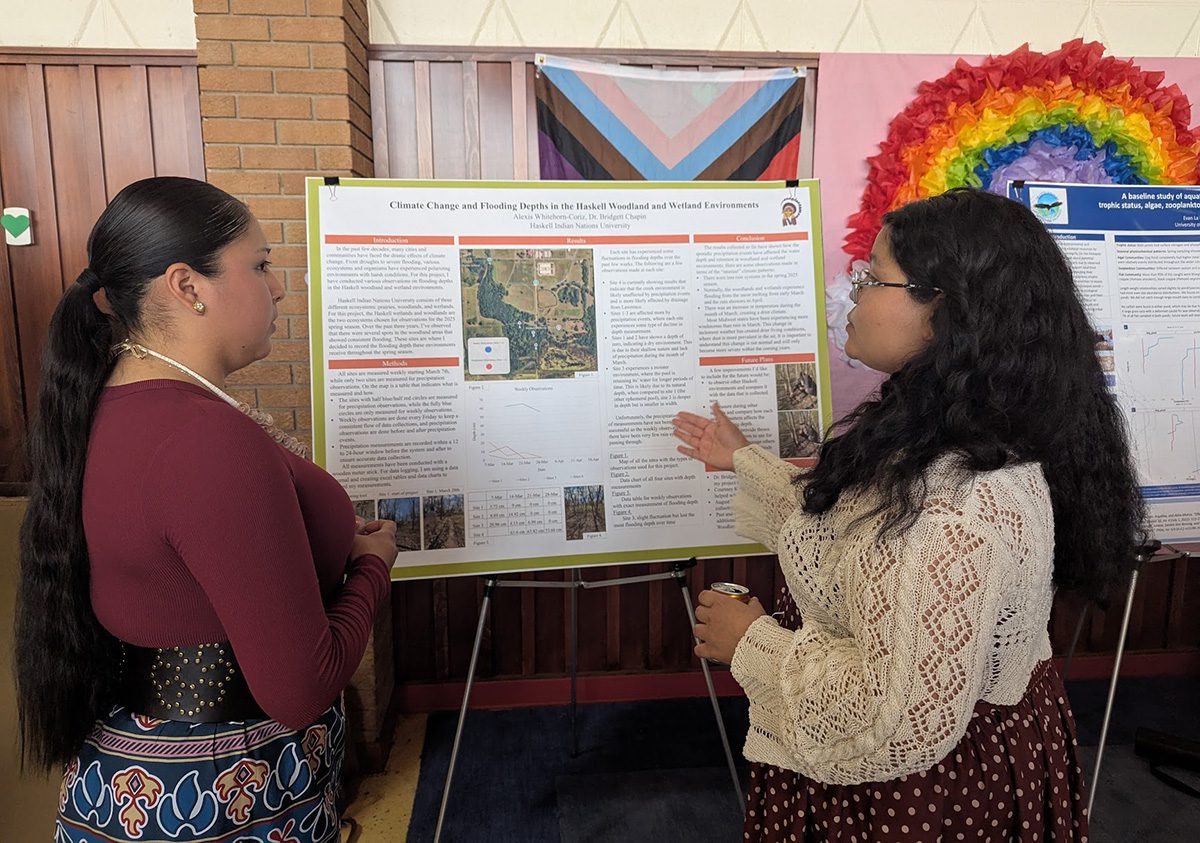
Alexis Whitehorn-Coriz, of the Three Affiliated Tribes, Santo Domingo Pueblo, is from Lawrence, KS and is a senior at Haskell Indian Nations University. Whitehorn-Coriz is a Haskell USDA NIFA Equity Student Researcher and a participant in the K-INBRE program. She is mentored by Nana Allison-Brewer, mathematics faculty at Haskell Indian Nations University (USDA NIFA Equity) and by Bridgett Chapin, faculty and chair of natural sciences at Haskell Indian Nations University (K-INBRE). Her research focuses on understanding flooding depths and precipitation patterns in the Haskell woodlands and Wetlands.
Malik Ali Zaidi Pons, of Puerto Rico, earned his bachelor’s degree in biomedical science from the Pontifical Catholic University of Puerto Rico in Ponce. Zaidi Pons is a postbaccalaureate scholar in the BioGEM program and is mentored by Ben Sikes, professor in ecology & evolutionary biology and senior scientist at the Kansas Biological Survey & Center for Ecological Research. Malik is co-mentored by graduate student Kit Savoy. His research focuses on how melanin pigmentation in soil fungi affects spore viability after radiation exposure.