Campus Safety Office
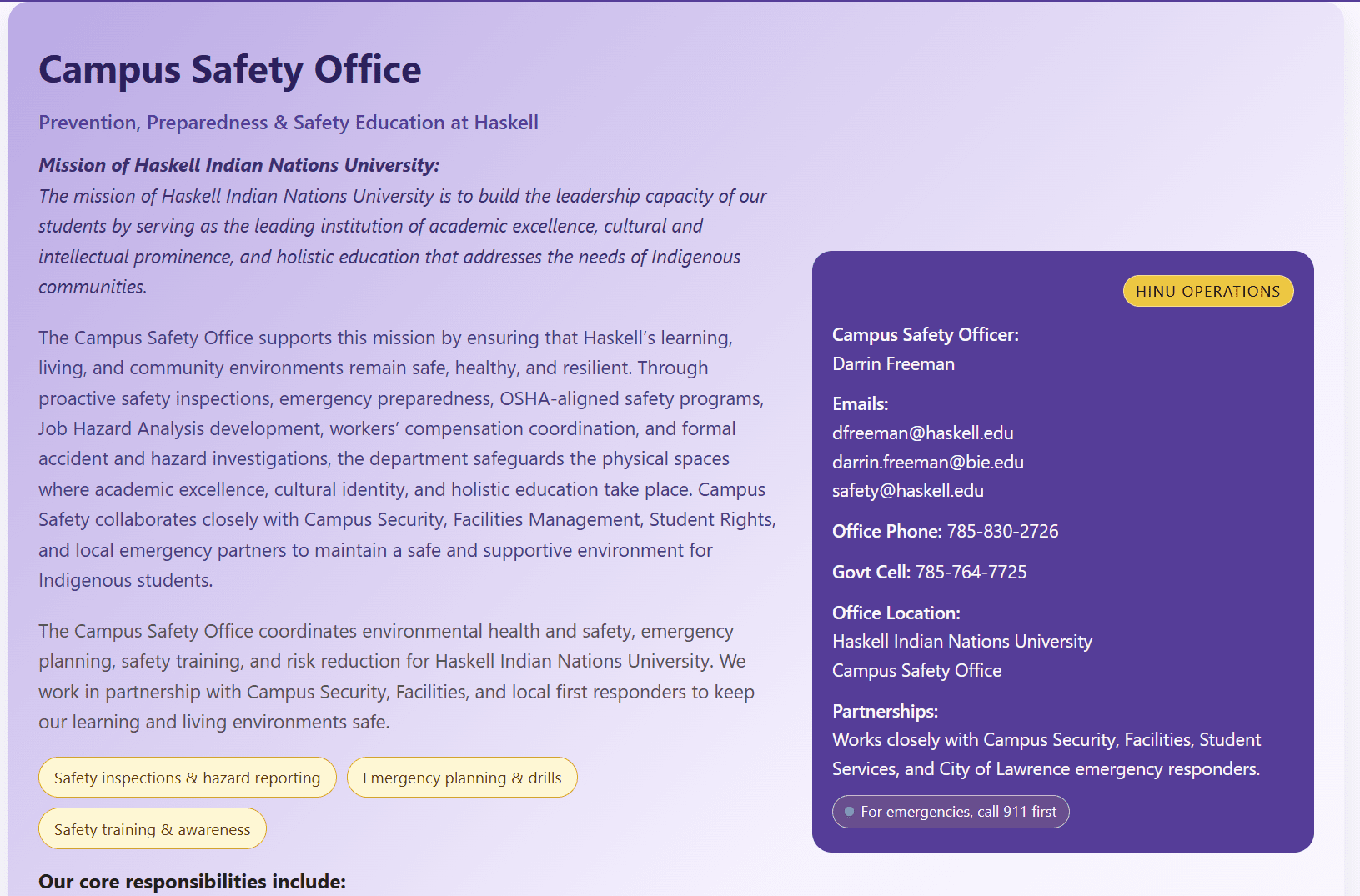
Mission of Haskell Indian Nations University:
The mission of Haskell Indian Nations University is to build the leadership capacity of our students by serving as the leading institution of academic excellence, cultural and intellectual prominence, and holistic education that addresses the needs of Indigenous communities.
The Campus Safety Office supports this mission by ensuring that Haskell’s learning, living, and community environments remain safe, healthy, and resilient. Through proactive safety inspections, emergency preparedness, OSHA‑aligned safety programs, Job Hazard Analysis development, workers’ compensation coordination, and formal accident and hazard investigations, the department safeguards the physical spaces where academic excellence, cultural identity, and holistic education take place. Campus Safety collaborates closely with Campus Security, Facilities Management, Student Rights, and local emergency partners to maintain a safe and supportive environment for Indigenous students.
The Campus Safety Office coordinates environmental health and safety, emergency planning, safety training, and risk reduction for Haskell Indian Nations University. We work in partnership with Campus Security, Facilities, and local first responders to keep our learning and living environments safe.
Our core responsibilities include:
- Coordinating safety inspections and corrective actions with Facilities Operations
- Developing and updating campus emergency response procedures
- Providing safety education, training, and outreach to students and employees
- Reviewing incident reports and recommending preventive measures
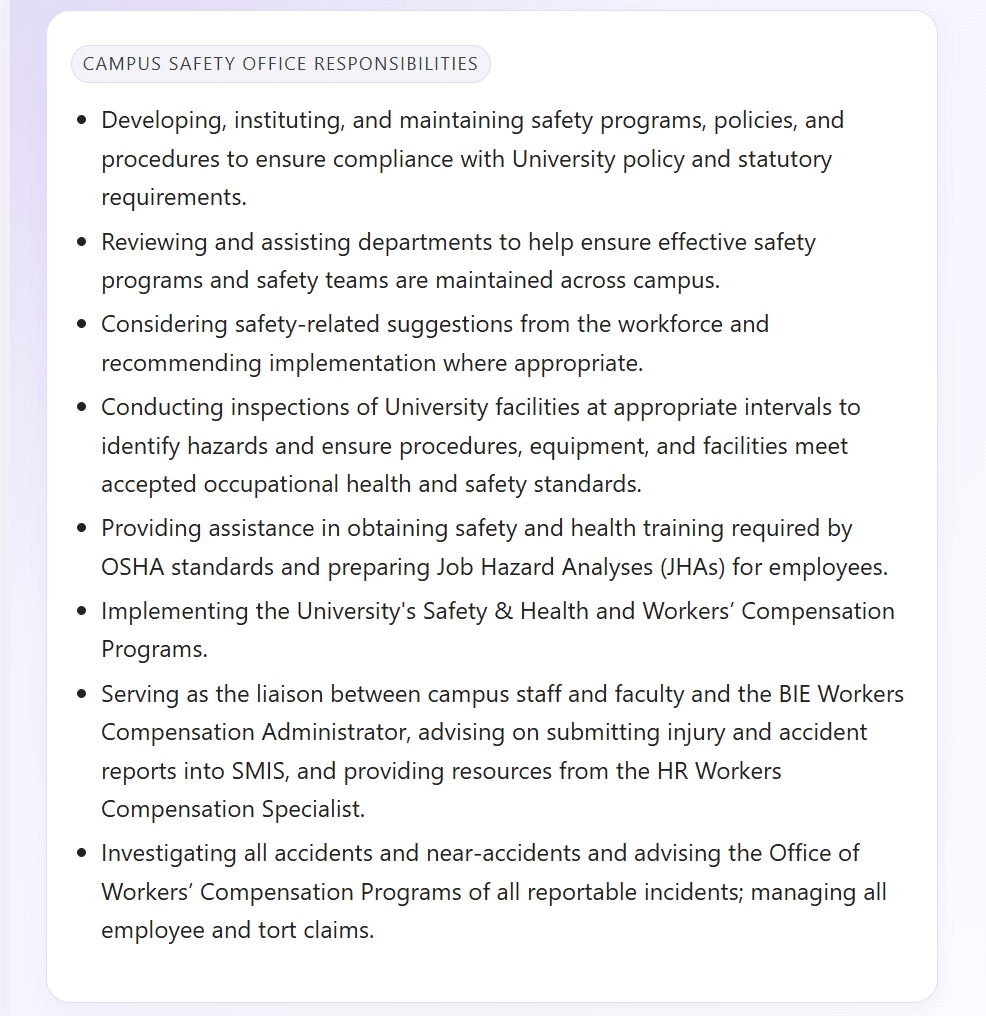
Campus Safety Office Responsibilities
- Developing, instituting, and maintaining safety programs, policies, and procedures to ensure compliance with University policy and statutory requirements.
- Reviewing and assisting departments to help ensure effective safety programs and safety teams are maintained across campus.
- Considering safety-related suggestions from the workforce and recommending implementation where appropriate.
- Conducting inspections of University facilities at appropriate intervals to identify hazards and ensure procedures, equipment, and facilities meet accepted occupational health and safety standards.
- Providing assistance in obtaining safety and health training required by OSHA standards and preparing Job Hazard Analyses (JHAs) for employees.
- Implementing the University’s Safety & Health and Workers’ Compensation Programs.
- Serving as the liaison between campus staff and faculty and the BIE Workers Compensation Administrator, advising on submitting injury and accident reports into SMIS, and providing resources from the HR Workers Compensation Specialist.
- Investigating all accidents and near-accidents and advising the Office of Workers’ Compensation Programs of all reportable incidents; managing all employee and tort claims.
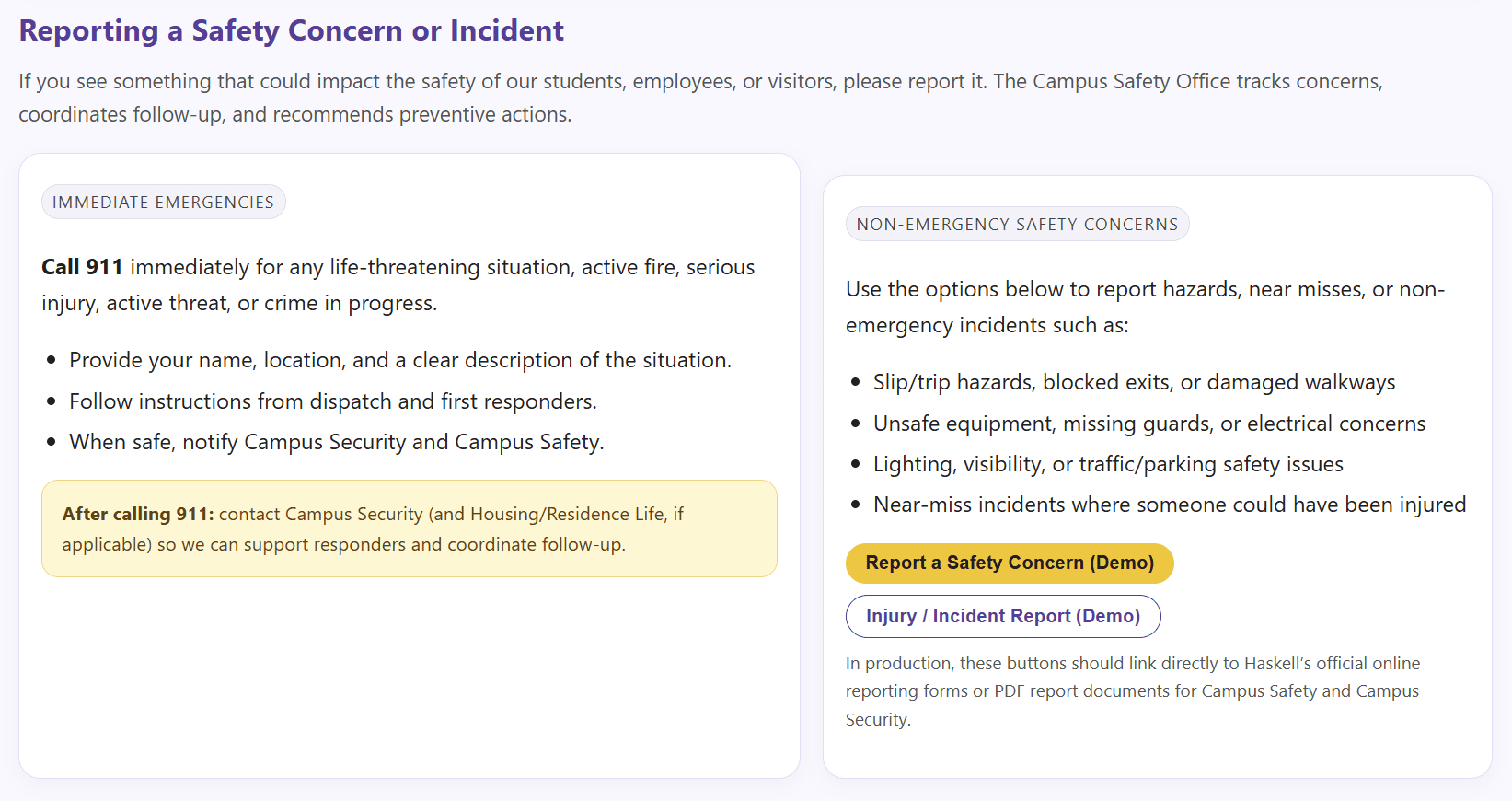
Reporting a Safety Concern or Incident
If you see something that could impact the safety of our students, employees, or visitors, please report it. The Campus Safety Office tracks concerns, coordinates follow-up, and recommends preventive actions.
Use the options below to report hazards, near misses, or non-emergency incidents such as:
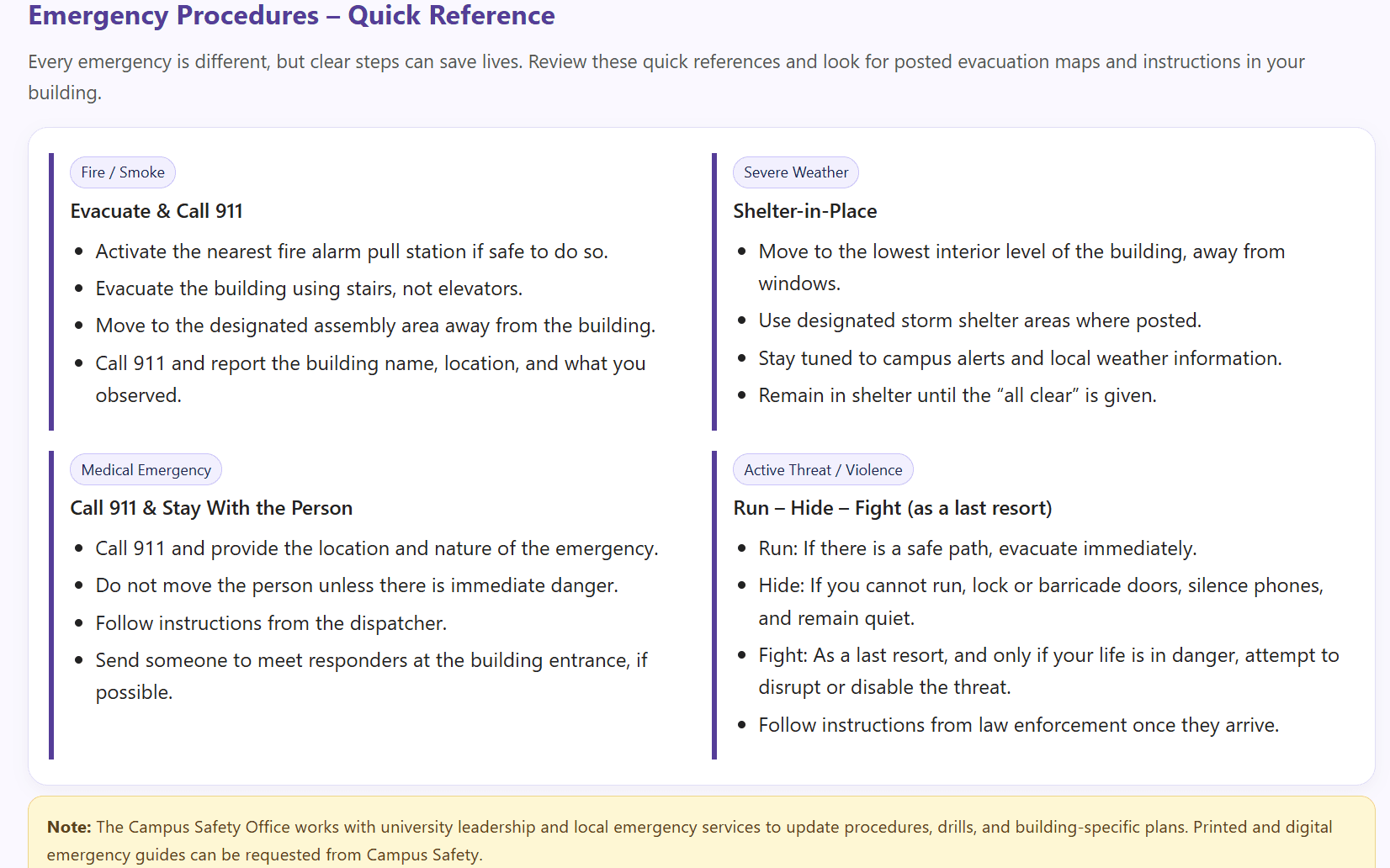
Emergency Procedures – Quick Reference
Every emergency is different, but clear steps can save lives. Review these quick references and look for posted evacuation maps and instructions in your building.
- Activate the nearest fire alarm pull station if safe to do so.
- Evacuate the building using stairs, not elevators.
- Move to the designated assembly area away from the building.
- Call 911 and report the building name, location, and what you observed.
- Move to the lowest interior level of the building, away from windows.
- Use designated storm shelter areas where posted.
- Stay tuned to campus alerts and local weather information.
- Remain in shelter until the “all clear” is given.
- Call 911 and provide the location and nature of the emergency.
- Do not move the person unless there is immediate danger.
- Follow instructions from the dispatcher.
- Send someone to meet responders at the building entrance, if possible.
- Run: If there is a safe path, evacuate immediately.
- Hide: If you cannot run, lock or barricade doors, silence phones, and remain quiet.
- Fight: As a last resort, and only if your life is in danger, attempt to disrupt or disable the threat.
- Follow instructions from law enforcement once they arrive.
Safety Inspections, Training & Resources
Campus Safety provides inspections, training, and reference materials to support a safe learning and working environment.
Inspections & Walkthroughs
- Periodic safety walkthroughs of classrooms, labs, public spaces, and grounds
- Coordination with Facilities for corrective work orders and follow-up
- Support for building-specific safety checklists and event risk reviews
- Feedback to supervisors and departments on recurring issues
Training & Awareness
- General campus safety orientation for students and employees
- Fire safety, evacuation drills, and severe weather response
- Slips, trips & falls prevention and housekeeping best practices
- Basic risk assessment for events and activities
(Email safetey@haskell.edu to request safety training)
Documents & Downloads
Campus Emergency Quick Reference (One-Page)
Printable summary of emergency procedures for offices, classrooms, and common areas.
Incident / Injury Report Form
Used to document work-related or campus-related injuries, near misses, and property damage.
Safety Inspection Checklist
A template departments can use for periodic self-inspections with Campus Safety and Facilities.
Annual Reports & Emergency Plans
Annual Security & Fire Safety Report
Official yearly safety and fire statistics for Haskell Indian Nations University.
Haskell Emergency Action Plan (EAP)
Campus-wide procedures for emergency response and critical incidents.
Frequently Asked Questions
Click on a question below to expand or collapse the answer.